
Safety data sheet
Standardized safety protocols and material specifications for professional use.
Certificate of Analysis
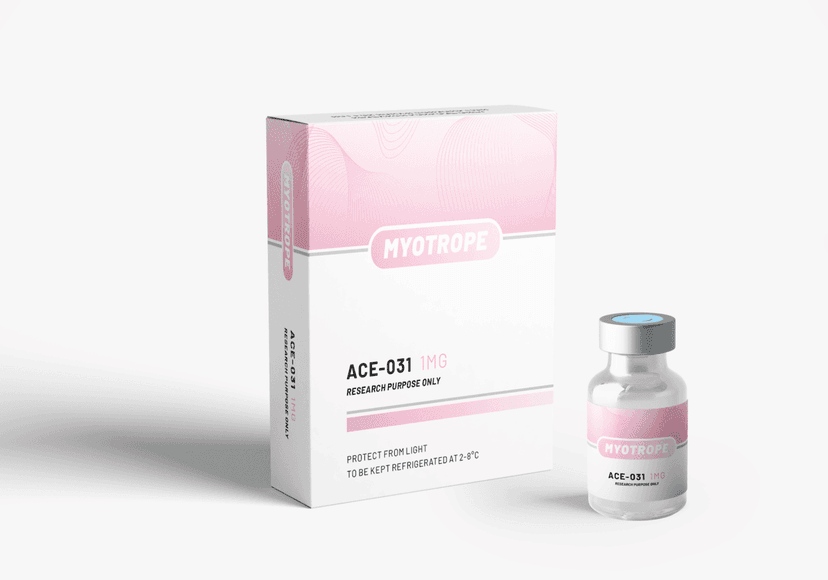
Purity verified via High-Performance Liquid Chromatography (HPLC) for #myo-ace-031-1mg
ACE-031 (1mg)
High >98% Purity
Authorized Resellers
Available through our trusted partners
123peptide.com
Netherlands · Europe
local_shipping2-3 Business Days
Depeptidenwinkel.com
Netherlands · Europe
local_shipping2-3 Business Days
Scientific Background
ACE-031 is a recombinant fusion protein combining a portion of the activin type IIB receptor with an antibody fragment. It acts as a decoy to bind and neutralize myostatin and related proteins that limit muscle development.
This soluble fusion of ACVR2B and IgG1-Fc targets myostatin and activins in the TGF-β family, preventing them from signaling through natural receptors. Preclinical models show it lifts restrictions on muscle cell growth and repair, leading to increased mass and strength.
In muscle expansion studies, it enhances size and force by countering inhibitory proteins, with rapid gains observed in young models. For wasting, it targets conditions like dystrophy and sarcopenia, potentially slowing loss and aiding function. In broader research probes, it influences bone density, fat storage, and even reproductive health through receptor interference.
Studies highlight its potential in addressing muscle loss from diseases, aging, or injury. Clinical development halted due to safety issues, but research continues in controlled laboratory settings.
Intended Research Use
- Myostatin inhibition and muscle hypertrophy research
- Muscle wasting disease models (dystrophy, sarcopenia)
- Tissue renewal and injury recovery studies
- Bone density and metabolic pathway investigations
- Cell proliferation and enlargement via blocked signaling
- Lean tissue and power enhancement in growth studies
menu_bookScientific Publications
Muscle Nerve (2013)
A single ascending-dose study of muscle regulator ACE-031 in healthy volunteers
open_in_newhttps://pubmed.ncbi.nlm.nih.gov/27462804/
Neuromuscul Disord (2020)
Update on ACE-031 Clinical Trials for Duchenne MD
open_in_newhttps://www.ncbi.nlm.nih.gov/pmc/articles/PMC7571243/
ResearchGate (2013)
ACE-031, a novel myostatin inhibitor, increases muscle mass and strength in young mice
open_in_newhttps://www.researchgate.net/publication/233738565_A_single_ascending-dose_study_of_muscle_regulator_ACE-031_in_healthy_volunteers
Biomedical Gerontology (2023)
Muscle regulator studies in aging models
open_in_newhttps://academic.oup.com/biomedgerontology/article/78/Supplement_1/32/7026116
Muscle Nerve (2012)
Myostatin and the Skeletal Muscle Atrophy and Hypertrophy Signaling Pathways
open_in_newhttps://onlinelibrary.wiley.com/doi/10.1002/mus.23539
Research Note: As an experimental compound, ACE-031 is supplied exclusively for scientific explorations into muscle regulation, hypertrophy, and wasting conditions. This product has no therapeutic approvals and is intended for laboratory research purposes only.
FOR RESEARCH USE ONLY. This product is intended for laboratory research purposes only and is not for human consumption, medical, or diagnostic use.
Possible stacks with other peptides
Synergistic combinations for enhanced research outcomes
Preclinical research indicates that pairing ACE-031 with synergistic agents can heighten its myostatin-blocking impact, potentially leading to greater muscle gains, better recovery, and improved metabolic outcomes in models of wasting or hypertrophy. These combinations are frequently examined in scenarios involving muscle disorders, aging, or performance, where multiple pathway targeting may yield amplified effects on tissue building and strength. Align stacks with specific research aims, monitoring for interactions in controlled laboratory settings.
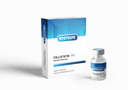
Follistatin 344 (1mg vial)
arrow_forwardmyo-follistatin-344-1mg
Researched for dual myostatin inhibition to maximize hypertrophy and wasting prevention
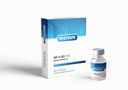
IGF-1 LR3 (1mg vial)
arrow_forwardmyo-igf-1-lr3-1mg
Explored for complementary growth signaling and muscle repair synergy
TB-500 (5mg vial)
arrow_forwardmyo-tb-500-5mg
Investigated for enhanced regeneration and injury recovery support
GDF-8 1mg (1mg vial)
arrow_forwardmyo-gdf-8-myostatin-1mg
Myostatin protein for direct regulatory studies — investigated alongside ACE-031 to understand the myostatin signaling axis in muscle wasting research.
Cycling Note: Cycling stacks in 4–8 week intervals with breaks may help maintain responsiveness, as sustained myostatin suppression could prompt adaptive changes in muscle models.